

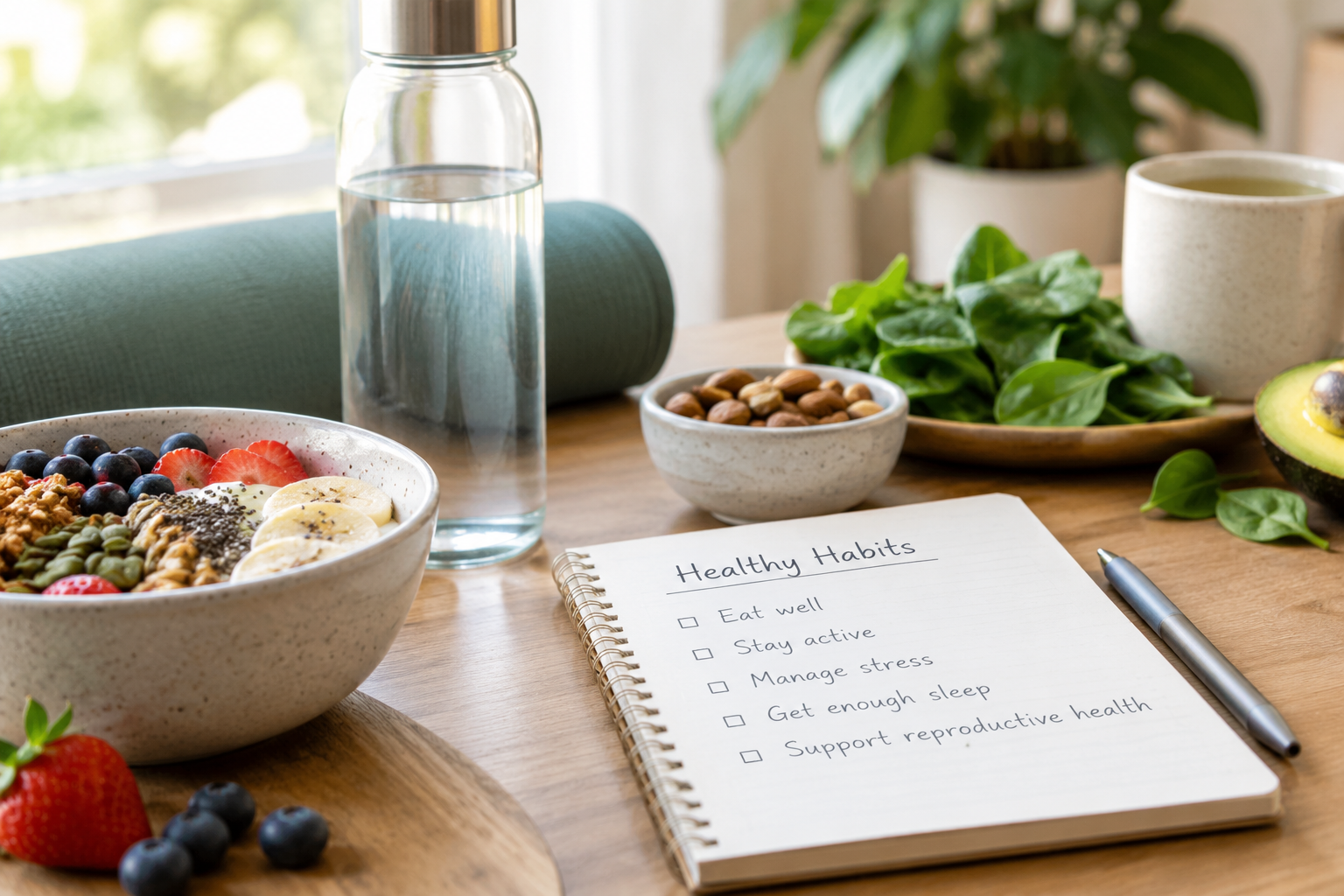
Spend ten minutes searching for advice on reproductive health and you will come away with a longer list of rules than you started with. One article insists on a supplement, another names foods to cut out entirely, and a third offers a plan that promises results in three months. It is noisy, often contradictory, and it tends to leave people feeling further behind rather than better informed.
This is the first edition of The Healthy Habits Edit, a new Heartomics series looking at the ordinary, repeatable habits that support different areas of health. No overhauls, no eliminations, no miracle ingredients. Just the things that are worth doing anyway, explained honestly, including where their limits are.
We are starting with reproductive health, because it is an area where the gap between what the evidence says and what the internet says is especially wide.
What the Evidence Actually Supports
Before the habits, some useful context. According to the NHS, around one in seven couples may have difficulty conceiving, while more than eight out of ten couples where the woman is under 40 will conceive naturally within a year of regular unprotected sex. In roughly a quarter of cases where there is a problem, no cause can be identified at all.
That last figure matters. It is a reminder that reproductive health is not a simple equation where good inputs produce a guaranteed output.
Build a Balanced Diet, Not a Fertility Diet
There is no single food, drink or supplement that has been shown to improve fertility. What general health guidance does support is a varied diet with enough fruit, vegetables, wholegrains, protein and healthy fats, which is the same advice that underpins the foundations of a healthy food plan more broadly.
One supplement does have specific preconception guidance behind it. NICE advises anyone planning a pregnancy to take 400 micrograms of folic acid a day, ideally starting three months before trying and continuing through the first 12 weeks. This is about reducing the risk of neural tube defects rather than improving fertility, which is a distinction worth holding onto.
Move Regularly Without Turning It Into a Project
The standard NHS activity guidelines of at least 150 minutes of moderate activity a week, plus strength work on two days, is a sensible target for most adults and does not need to be rebuilt around trying to conceive. Walking, cycling, swimming and garden-based activity all count.
Treat Sleep as a Habit, Not a Luxury
Sleep is the habit people cut first and notice last. Poor sleep affects appetite, mood, motivation and the capacity to keep other habits going, which makes it foundational rather than optional. If falling asleep is the sticking point, our guide on what to do when you cannot sleep covers the practical ground.
Manage Stress Realistically
Stress will not be eliminated, and being told to relax is rarely useful advice for anyone trying to conceive. What is worth knowing is that the NHS lists stress among the factors that can affect fertility, partly through its effect on relationships and sex drive, and in severe cases through ovulation and sperm production. Finding something that genuinely lowers your baseline, whether that is exercise, time outdoors, counselling or simply a lighter schedule, is a reasonable thing to prioritise.
Think About Weight as a Range
Weight matters at both ends of the scale. NHS preconception advice puts it plainly: if your weight is too low or too high it can make conceiving harder, and a GP can help you manage it. The NHS also notes that a BMI of 30 or over reduces fertility in both men and women, and that being overweight or significantly underweight can affect ovulation. Rather than fixing on a single number, the more useful framing is a range you can hold onto without resorting to an extreme diet.
Review Smoking and Alcohol
This is the area where the advice is least ambiguous. Smoking, including passive smoking, affects the chance of conceiving and can reduce semen quality. On alcohol, the safest approach when trying to conceive is not to drink at all, and heavy drinking can affect sperm quality too.

Why Habits Are Supportive, Not a Guarantee
Here is the part that most lifestyle content leaves out. Good habits support general health, and general health supports reproductive health. Neither prevents fertility problems, and no amount of clean eating overrides biology. It helps to be clear about which is which.
| Influenced by everyday habits | Not changed by habits |
|---|---|
| Smoking, including passive smoke exposure | Age, which remains one of the strongest influences on fertility |
| Alcohol intake | Endometriosis and similar reproductive conditions |
| Keeping weight within a healthy range | Irregular or absent ovulation |
| Activity levels and general fitness | Blocked or damaged fallopian tubes |
| Sleep and day to day stress levels | Underlying medical causes of poor semen quality |
| Taking folic acid before conception | Cases where no cause can be identified at all |
The right-hand column is not a list of things to worry about. It is a list of things that have their own clinical pathways, which is why habits are a starting point rather than an answer. Male fertility sits in that column more often than general advice suggests, and it is still sometimes treated as an afterthought.
Anyone who has been doing everything right and is still waiting deserves better than the implication that they have not tried hard enough.
When It Is Worth Asking for Advice
The NHS suggests speaking to a GP if you have not conceived after a year of trying, and sooner if you are 36 or over, or if you already know there may be a fertility issue. Tests usually involve both partners rather than one. NG257, the NICE fertility guideline updated in March 2026, sets out how fertility problems should be assessed and treated so that care is more consistent wherever you live. Specialist services such as Hull & East Riding Fertility carry out testing and consultations for people referred by a GP as well as those arranging care privately. The NHS also advises checking that any private clinic is licensed by the HFEA.
A short list of things worth doing before an appointment:
- Note roughly how long you have been trying and how regular your cycles are
- Write down any existing diagnoses, surgeries or medications for both partners
- Check whether you are up to date with cervical screening
- Start folic acid if you have not already
- Bring your questions written down, because appointments go quickly
Less Noise, Fewer Rules
The appeal of a fertility diet or a strict protocol is that it offers control over something that often feels uncontrollable. The honest version is quieter: eat reasonably well, move most days, sleep properly, drink less, stop smoking, and get advice when the timeline suggests you should. These habits are worth building for your health regardless of the outcome, which is exactly why they are a better place to start than a list of rules someone else wrote.
The Healthy Habits Edit continues with the next instalment soon.

